Picking the right affiliate offers
How to Find Affiliate Programs in Your Niche
Five ways to find affiliate programs in any niche, including the ones no list covers, and how to tell in two minutes whether one is worth joining.
There are five ways to find affiliate programs in your niche, and the one that works for a niche nobody writes about is the one almost nobody mentions: search the companies themselves instead of searching for lists. Affiliate networks will show you a few thousand programs. A directory will show you the same twenty every article recommends. Neither one will find the small company in your niche paying 30 percent with a 45 day cookie, because nobody ever added it to a list.
One of the things I learned to look at when choosing a company is longevity. I have seen companies come and go. Getting behind a brand that clearly had no intention of being around for a while is a sign I learned not to ignore. What I came to realize is that the right company has the right people behind it and the right products behind it, so that if you wanted to promote them for years to come, you could. Early on I would come across a hot opportunity that buzzed with hype and I would join out of FOMO. Looking a little deeper into the people running a company before I put my reputation on the line became my top priority.
The four places everyone tells you to look
These are the four methods in every article on this subject. They are not wrong. They are just incomplete, and being honest about what each one is good at is the fastest way to see the gap they leave.
Affiliate networks
Places like ShareASale, CJ, Impact and ClickBank sit between you and hundreds of companies. Good for: one login, one payment, tracking that works, and a company that has already agreed to pay affiliates. The limit: you only see companies that joined that network, and joining a network costs the company money. Plenty of good ones never bother.
Amazon Associates
Good for: almost anything physical, approval is straightforward, and people already trust the checkout, which matters more than beginners expect. The limit: Amazon sets its rates by product category and publishes them inside your Associates account, and they sit at the low end of what you will see anywhere else in this article. The tracking window is also much shorter than the 30 days that is normal elsewhere.
Affiliate directories
Good for: browsing when you have no idea where to start. The limit: directories are lists, and lists go stale. A commission rate published two years ago is a guess, not a fact, and the same well known programs sit at the top of every directory because they are the ones paying to be seen.
Asking the company directly
Good for: this is the only method that reaches small companies, and small companies in a specific niche are often where the best terms are. The limit: it is slow, and most of them will not reply. Worth it anyway, and the reason why is in the next section.
How to find affiliate programs in your niche when the lists do not cover it
Everything above searches for programs. This searches for companies, which is a different thing and it is the part that works in a niche nobody writes about. Five steps, and you can do the whole thing in an evening.
- Write down 15 to 20 companies that sell to your niche. Not the biggest companies. The ones the people in your niche actually buy from, including the ones you have bought from yourself.
- Search each company name followed by the word affiliate. That is it. Most programs are found by this one search and nothing else.
- If nothing comes up, open the company website and look at the footer. Affiliate program links live in the footer far more often than in the menu, because the company is not advertising it to customers.
- Still nothing? Search for the company inside one of the networks above. Some companies run a program through a network and never mention it on their own site.
- Still nothing, and you genuinely like them? Email them and ask. Small companies say yes more often than people expect, and some will set something up because you asked.
This is why the method matters. When I ran this across my own data, the niches with the most programs available were not the ones the articles cover. Hunting turned up 27 programs. Golf turned up 23. Cookware 23. Perfume 18. Collectibles 14. Those are not niches you will find in a list of the best affiliate programs for beginners, and that is exactly the point: fewer people are competing for them.
Five things to check before you join
This is a two minute job per program and it is the difference between a program that pays you and a program that wastes a year of your work.
- The commission, and whether it is a percentage or a flat fee. A flat fee of $80 beats 30 percent of a $40 product and it is not close. Write down both numbers, not just the percentage.
- The cookie window. This is how long after someone clicks your link that a sale still counts as yours. Of the 390 programs in my data that published this, 288 were 30 days or less and only 49 were 90 days or more. A 7 day window means a person who thinks about it for a week buys from you and pays you nothing.
- The payout threshold. Some programs hold your money until you have earned $50 or $100. If you are earning $12 a sale, that is your first several sales sitting in someone else's account.
- When they actually pay. Net 30 means 30 days after the month ends, so a sale on the 2nd of the month can be nine weeks from money. This is the single most common surprise for people starting out.
- What they require of you. Some programs want an existing audience, a live website, or for you to have bought the product. Find this out before you write anything, not after.
What the numbers actually look like
Most articles about affiliate programs quote a range for a whole category and never say where the number came from. These figures come from my own research across 634 affiliate programs in 41 niches, where every value was read from the program's own page and recorded with the link it came from.
- The median commission was 10 percent, among the programs that published one.
- The median cookie window was 30 days.
- The median estimated earnings per sale was $13.37.
- Only 82 of 634 paid recurring commission, so the monthly income everyone talks about is the exception rather than the normal case.
- Only 357 of the 634 published a commission rate at all. More than a third of affiliate programs will not tell you what they pay until you are inside.
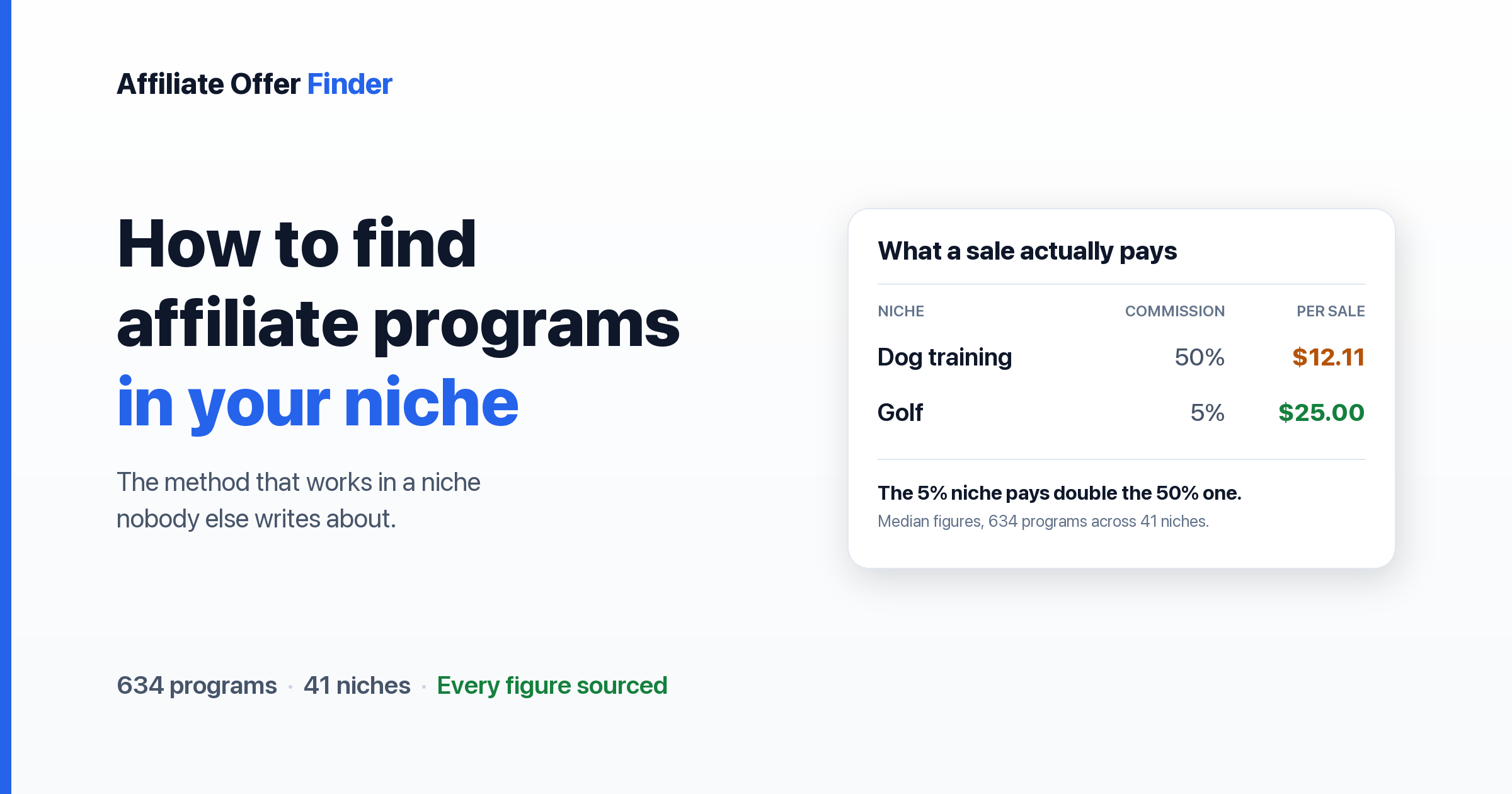
And here is the finding that surprised me most, which is that the commission percentage is close to useless on its own. Golf programs paid a median of 5 percent and earned about $25 a sale. Dog training paid 50 percent and earned about $12. Ten times the commission rate, half the money, because what decides your paycheck is the price of the thing being bought, and the percentage is the only number most articles print. I pulled that apart properly in does a high commission rate mean more money, with the figures for every niche.
The gap between niches is bigger than most people would guess. Social media marketing courses had a median estimated $303 a sale. Collectibles had $1.50. Getting a click costs the same amount of work in both.
What I use
I created this tool (Affiliate offer finder) because I got tired of seeing people promote dead end affiliate offers in the niche I was in. Over the years I've been asked things like "How do I get started with affiliate marketing", "Whats the 1st steps to affiliate marketing", etc. One of the 1st steps to making money with affiliate marketing is picking the right offer with the right company to standby and promote. This tool will show you companies in your niche to join and it can expose the ones you may want to think twice about promoting. I will be creating more posts and trainings on picking the right affiliate programs to join.
Affiliate Offer Finder does the company by company search in this article automatically for whatever niche you type, and reports the five things above for each program it finds, with a link to the page every figure was read from. The first three searches are free and there is no card. After that a full report is $5, paid once, with no subscription.
Every paid report also comes with two things at no extra cost, and both exist because picking the offer is only the first step. Getting traffic to it is the real work.
- A 5 day jumpstart marketing plan, tailored to the exact niche you searched. Not a generic template with your niche pasted into it. It is written for the niche in front of you, so day one is something you can actually do that day.
- A personal video review of your social media account and your first posts, recorded by me. You fill in a short form about what you are promoting and where you are posting it, and the video shows up in your dashboard. It is aimed at one thing: getting real traffic to your affiliate links instead of guessing.
Common questions
Do I need a website to join an affiliate program?
How much do affiliate programs pay?
What is a cookie window and why does it matter?
Do I have to tell people my links are affiliate links?
Sources
- Commission, cookie and payout figures: my own research across 634 affiliate programs in 41 niches, November 2026.
- FTC Endorsement Guides: What People Are Asking for the disclosure rules.
- Network terms were taken from ShareASale, CJ, Impact and ClickBank directly.