Picking offers
Does a High Commission Rate Mean More Money?
No. Across 634 affiliate programs in 41 niches, a 5 percent niche paid double what a 50 percent niche paid per sale. Here is the number to work out instead.
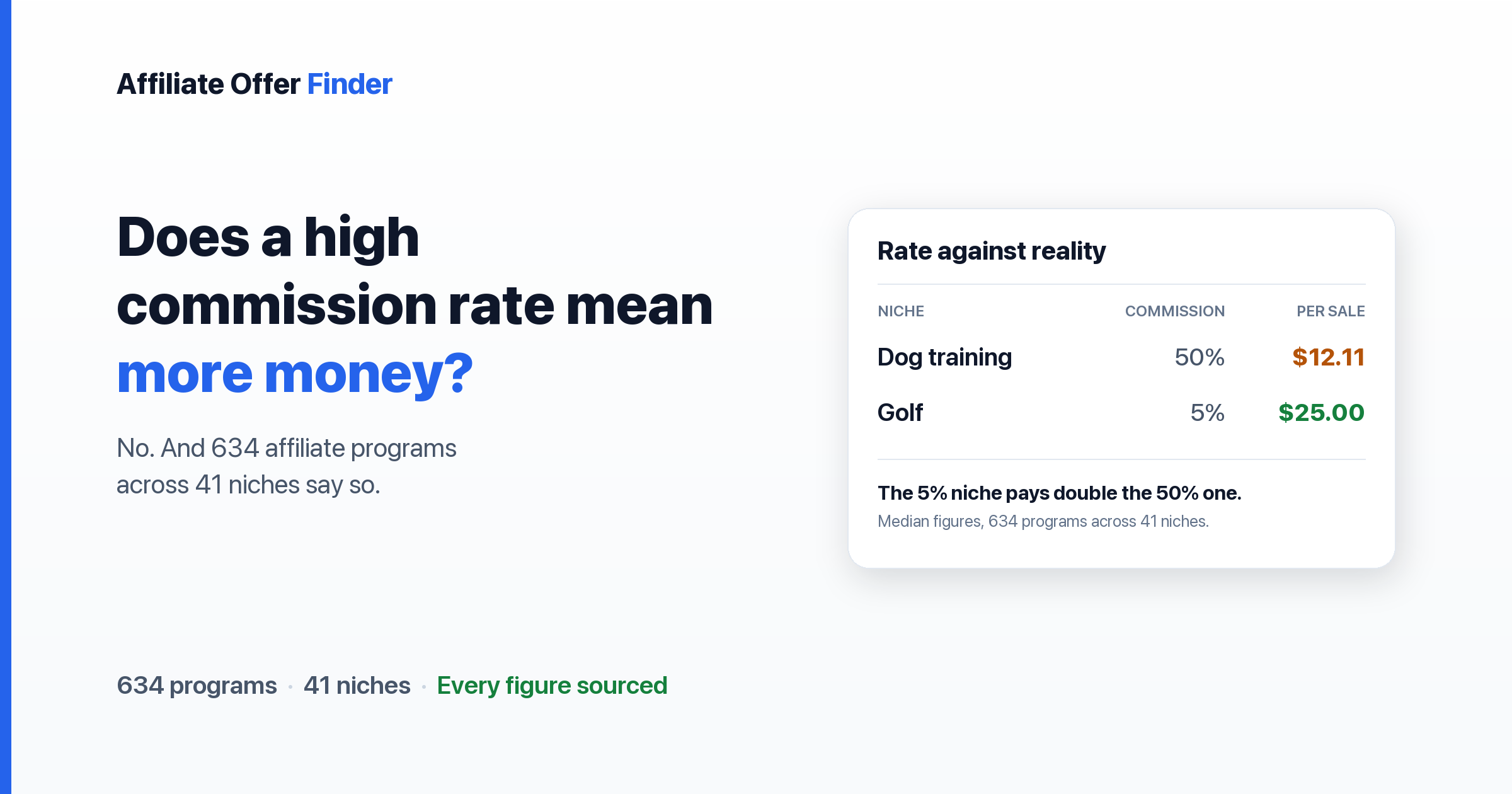
No. A high commission rate does not automatically mean more money, and in my own research it often meant the opposite. Across 634 affiliate programs in 41 niches, the niches paying the highest percentages were frequently the ones paying the least per sale. Dog training programs paid a median of 50 percent and worked out to about $12.11 a sale. Golf paid a median of 5 percent and worked out to about $25.00. The percentage is the number every article prints, and on its own it tells you almost nothing about what lands in your account.
I promoted low ticket offers for most of my affiliate marketing journey, and I can confidently say low ticket is greatly underestimated in the affiliate marketing space right now. In 2017 a company I promoted let me support myself fully and comfortably. I made a little over $3 for every person I brought in as a good quality lead through my affiliate link. There was no commission percentage in that deal at all, and I am sure they made far more from each lead than I did. It did not matter. Three dollars a time adds up quickly once you have consistent traffic, and traffic is a post of its own.
Don't get me wrong. High ticket affiliate marketing is powerful and I want you to add it to your income. But low ticket is a great way to get your foot in the door of consistent passive income, and to get paid while you build your following and your email list. The rate on the page was never the thing that decided what I earned.
Where these numbers come from
Most articles about commission rates quote a range for a whole category and never say where it came from. These figures are from my own research: 634 affiliate programs across 41 niches, where every commission rate and cookie window was read from the program's own page and recorded along with the link it came from.
- The median commission was 10 percent, among the 357 programs that published one.
- The median cookie window was 30 days.
- The median estimated earnings per sale was $13.37.
- Only 357 of the 634 published a commission rate at all. More than a third of affiliate programs will not tell you what they pay until you are already inside.
The high commission niches that pay the least
Here are the niches with the highest median commission rates in my data, with what a sale is actually estimated to be worth in each one. Read the two columns together rather than the first one alone.
- Dog training: 50 percent, about $12.11 a sale. The highest rate in the whole dataset and well below the typical payout.
- Self help: 35 percent, about $49.50 a sale. A high rate that does pay, because the products cost more.
- Business coaching: 35 percent, about $29.10 a sale.
- Education: 30 percent, about $11.77 a sale. Another high rate on low priced products.
- Weight loss: 27.5 percent, about $10.00 a sale. One of the most competitive niches there is, paying ten dollars.
The low commission niches that pay more
Now the other direction. These are niches whose rates look disappointing on a list and whose sales are worth more.
- Golf: 5 percent, about $25.00 a sale. One tenth the rate of dog training and roughly double the money.
- Fitness: 8 percent, about $29.99 a sale. Also worth noting because the figure everyone repeats for health and fitness is 15 to 30 percent, and my 14 fitness programs say 8.
- Cookware: 5.5 percent, about $19.00 a sale.
- AI hardware: 2.75 percent, about $13.07 a sale. The lowest median rate in the data, still paying above the overall median per sale.
Why a high commission rate can mean less money
It is arithmetic, not a trick. A commission is a percentage of a price, so the price decides the outcome. Fifty percent of a $25 ebook is $12.50. Five percent of a $500 set of golf clubs is $25. The niche with the worse looking rate wins because the thing being bought costs twenty times more.
High percentages cluster around digital products, which cost almost nothing to deliver, so the seller can afford to give away half. Low percentages cluster around physical goods with real manufacturing costs, where the seller has a few points of margin to share. Neither one is generosity or stinginess. It is what the product costs to make.
Which means a high commission rate is often a signal that you are about to promote something cheap.
The number to work out instead
Before you judge any program, do this one calculation. It takes ten seconds and it is the only number that describes what you will be paid.
- Find the typical price of what you would be promoting. Not the cheapest thing they sell and not the flagship, the one most people actually buy.
- Multiply it by the commission rate. That is roughly what one sale pays you.
- Now divide the amount you want to earn in a month by that number. That is how many sales a month you need.
- Sit with that last figure before you decide. Ten sales a month and two thousand sales a month are different lives, and the commission rate alone will not tell you which one you signed up for.
Here is the same point at the two extremes of my data. In social media marketing courses, a median sale is worth about $303, so $3,000 a month is about ten sales. In collectibles, a median sale is worth about $1.50, so $3,000 a month is around two thousand sales. Same effort to earn the click. Completely different amount of traffic needed to live on it.
What else to look at before you commit
Earnings per sale is the number the rate hides, but it is not the only one worth checking. The full method for finding and judging programs in your niche covers the rest: the cookie window, the payout threshold, when they actually pay and what they require of you.
Two from my data worth holding onto. Of the 390 programs that published a cookie window, 288 were 30 days or less and only 49 were 90 days or more. And only 82 of the 634 paid recurring commission at all, so the monthly income everybody talks about is the exception rather than the normal case.
What I use
Affiliate Offer Finder runs this research for whatever niche you type and reports the commission, the cookie window, the payout terms and an estimated value per sale for every program it finds, each figure linked to the page it was read from. The first three searches are free and there is no card. After that a full report is $5, paid once, with no subscription.
Every paid report also comes with two things at no extra cost.
- 🎁 A 5 day jumpstart marketing plan, tailored to the exact niche you searched.
- 🎁 A personal video review of your social media account and your first posts, recorded by me and delivered to your dashboard.
See what your niche actually pays
Common questions
Does a high commission rate mean more money?
What is a good affiliate commission rate?
Why do digital products pay such high commission?
How many sales do I need to make $3,000 a month?
Sources
- Commission, cookie and per sale figures: my own research across 634 affiliate programs in 41 niches, November 2026. Every figure was read from the program's own published page.
- Method for gathering them: How to Find Affiliate Programs in Your Niche.
- FTC Endorsement Guides: What People Are Asking for how affiliate links must be disclosed.